NeolemonNeolemonvsIdeogramIdeogram

The same character on every page.

Ideogram makes one beautiful image, and its text rendering is the best in the business. Neolemon keeps your cartoon hero the same across all 32 pages, which is the part that drifts by page eight.

20 free credits. No card required.

4.5
Trustpilot, 94% 5-star
1M+
uses on our GPT
60%
publish to KDP
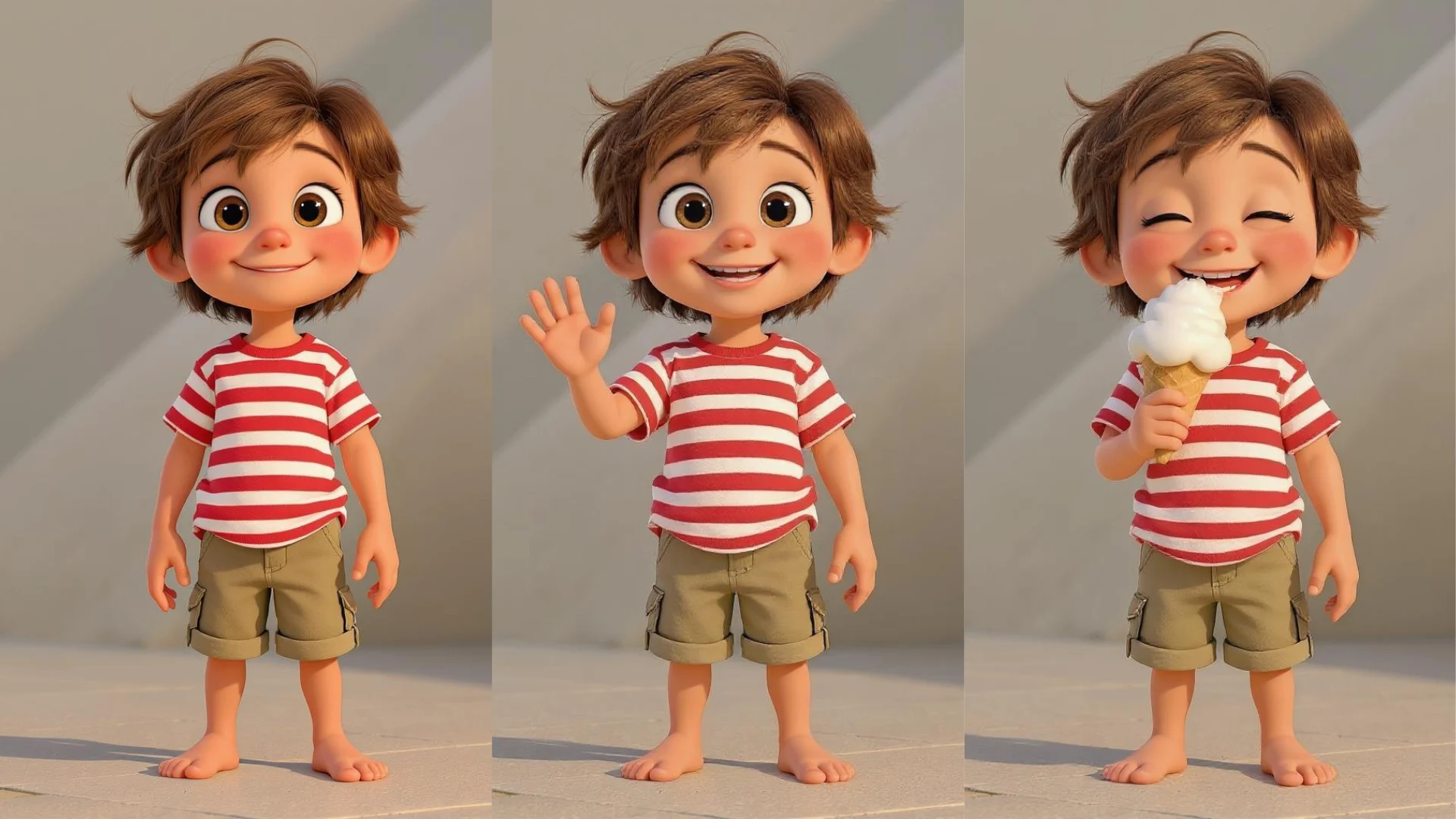
The same cartoon boy in three poses with an identical face, hair, and outfit

One character. Three poses. Zero drift.

The short answer

Who each one is for.

You probably tried Ideogram on a children's book or a comic and watched the character change faces. Here is the honest split before any of the detail.

Choose Ideogram

The image is the deliverable: a poster, a logo, a book cover with title lettering, an ad, a photoreal scene, or twenty concepts in twenty styles. Its typography and range are hard to beat.

Choose Neolemon

The story is the deliverable, and one cartoon character has to stay recognisable across every page, in the poses, expressions, outfits, and scenes you wrote.

Use both

Cover and marketing graphics in Ideogram, interior characters in Neolemon. Plenty of authors run exactly that stack.

The whole comparison in one line

Ideogram is a general image platform. Neolemon is character-first.

Ideogram has character reference, and it works for one-shot identity transfer. But it lives inside a tool built to make any image. Neolemon is a workshop built around one job: holding a single cartoon character on-model across a whole story.

On a real multi-view production test, Ideogram's character feature was "a miss 50% of the time."
andupotorac, testing single-reference consistency on r/StableDiffusion. One front-facing reference still has to invent the side and back. That gap, across many pages, is the whole reason this page exists.

What you're comparing

Two tools, two jobs.

A lot of "Ideogram alternative" pages still describe a 2023 tool that only spelled words. Here is what each one actually is in 2026.

Ideogram

Ideogram

A general image and design platform

A proprietary image model from ex-Google Brain researchers, wrapped in a fast creative app. Strong everywhere, deepest on typography.

  • Text inside images. Its home turf: posters, logos, t-shirt graphics, book-cover lettering, ad creative. Nothing renders words better.
  • Broad generation. Photoreal, design, 3D, anime, with style references, colour palettes, magic prompt, remix, and batch.
  • Character reference. One photo keeps a person recognisable across pose, outfit, and lighting. Real, and useful for a few similar shots.
  • Custom models and API. Train on 15 to 100 images on Pro and up; a broad API for developers and agencies.
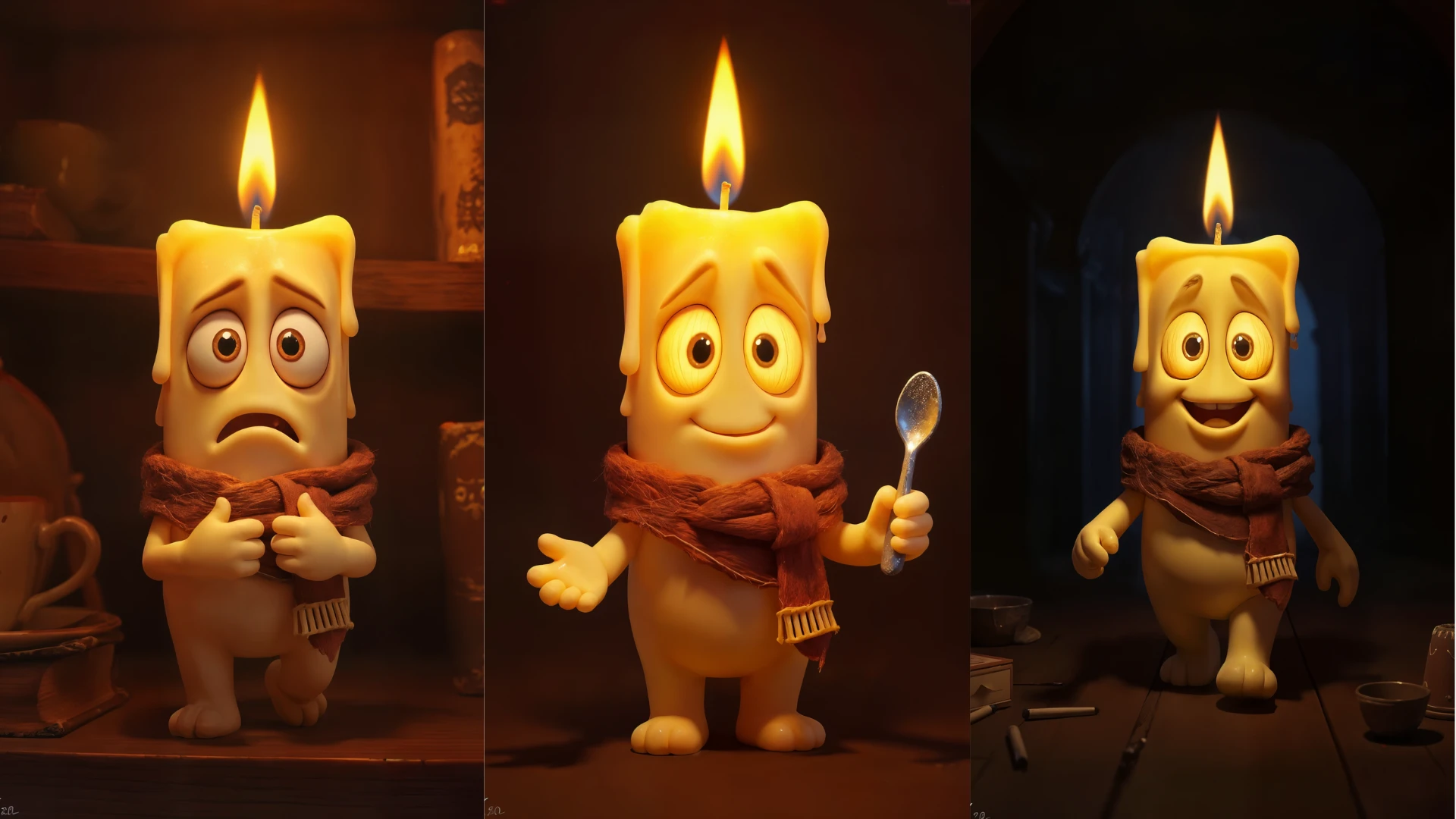
A range of cartoon art styles generated from the same character description
Neolemon

Neolemon

A character workshop

Formerly ConsistentCharacter.ai. Cartoon-only since 2025. You build one anchor character, then direct it scene by scene. The book is what you make with the character.

  • Character Turbo builds the anchor from structured Description, Action, Background, and Style fields.
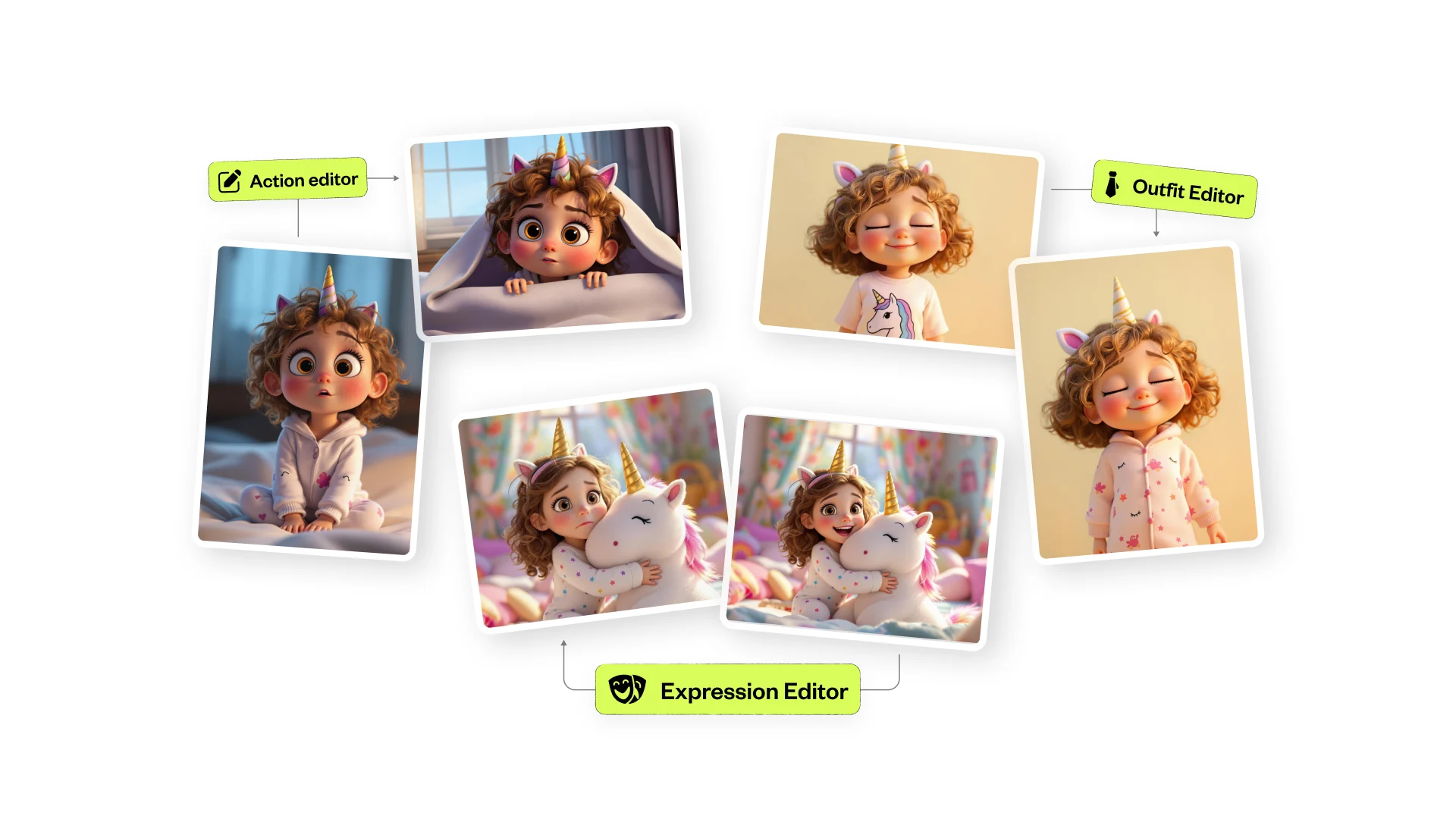
  • Action, Expression, Outfit, Perspective editors each change one thing at a time, identity locked.
  • Multi Character and Story Scene Pro compose up to three named characters with a background reference.
  • AI Canvas, Coloring Book Creator, Storyboard carry you from assets to a laid-out book.
Neolemon editors generating the same character in different poses and outfits

The distinction nobody draws

Two different consistency problems.

Most comparisons blur all AI image generation together. There are really two separate problems, and each tool owns one of them.

Text consistency

Can it spell the words inside the image?

Legible, well-placed typography in a poster, a logo, a quote card, a cover title. This is genuinely hard for image models, and Ideogram is the leader. Its users say so unprompted.

"Texts are always typed exactly as you want them."
Yohana M., on Trustpilot

Winner: Ideogram. We don't try to render words inside artwork, and we won't pretend otherwise.

Character consistency

Can it keep the same character across 30 scenes?

Same face, hair, proportions, outfit, and art style, while the pose, expression, and background all change, page after page. This is the storybook problem, and it's the entire reason Neolemon exists.

Illustrated 20 books in 4 months. Her old workflow took roughly three days per character.
Naomi Goredema, children's author (Nandi Books)

Winner: Neolemon. A reference slot helps one shot. A story needs a workflow.

Ideogram solved text rendering and added character reference on top. Neolemon built the entire product around character consistency. If your project mostly needs the first, use Ideogram. If it lives or dies on the second, keep reading.

How consistency actually works

Lock the face. Change everything else.

Any tool can make one cute character. It falls apart around page 20, after your hero has been regenerated into thirty new scenes and quietly stopped being the same kid. Neolemon never re-rolls the character.

1

Anchor

One clean front view in Character Turbo. Every scene derives from this single reference.

2

Pose it

Action Editor changes the pose. Face, outfit, and style stay exactly where they were.

3

Emote it

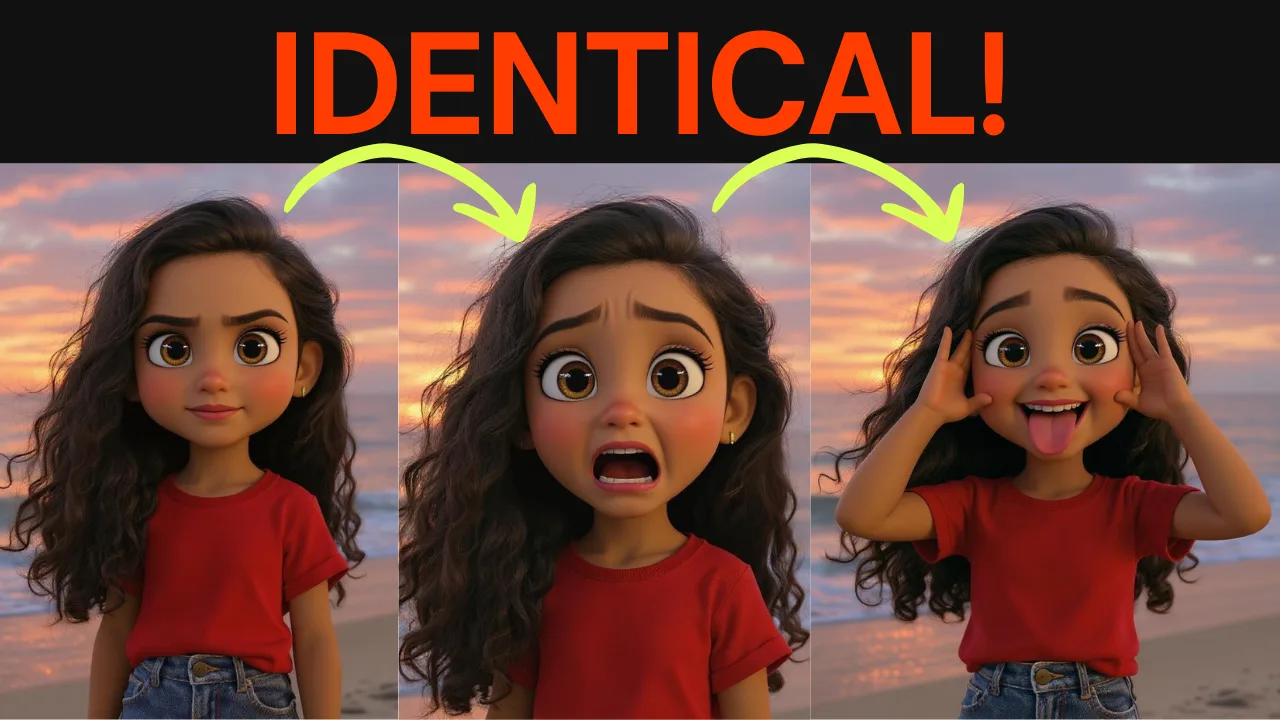
Expression Editor moves the eyes, brows, and mouth. Same child, twelve different feelings.

4

Compose it

Drop the character into a background, or compose several with Story Scene Pro. No identity blending.

The same cartoon girl in three expressions, labelled identical

One slot, or one tool per job

Ideogram routes pose, expression, outfit, and angle through a single character-reference slot and a mask. Its own docs note the mask can keep too much hair and ignore your hairstyle prompt, and a pendant can vanish unless you add it back by hand.

Neolemon splits those into separate editors, each constrained to change only its own thing. It's a workflow for controlling consistency, not a wish for it. The same approach powers the developer model on Segmind: a character reference plus an optional pose reference.

The detail a shallow comparison misses

A book needs more than one thing locked at once.

For a 32-page picture book you don't just need the same face. You need the same face, the same outfit world, the same illustration style, the same colour palette, and repeatable control, all at the same time.

In Ideogram, with character reference on

3 off

Its own docs say colour palette, negative prompt, and seed become unavailable, and a selected style reference is disabled, while character reference is active. Locking everything at once isn't a simple all-controls-on flow.

In Ideogram, per generation

1 ref

The v3 API supports one character reference image. A front-facing photo forces the model to invent the rear and profile views your story still needs.

In Neolemon

Each separate

Identity, action, expression, outfit, and perspective are separate, reusable steps. You change one variable at a time and the rest holds.

None of this means Ideogram is bad at characters. It means a general tool spreads its controls across one slot, where a character tool gives each job its own. For one hero shot that rarely bites. For a whole book, it's the first wall you hit.

Feature by feature

The full comparison.

Grouped by what you're actually deciding on. Where Ideogram is the stronger pick, it says so plainly, and it wins more rows than a lazy comparison would show.

Capability Ideogram Neolemon
Character control
Consistency across many pagesOne reference slot plus a maskThe core product: anchor plus editors
Pose and actionThrough prompt and maskDedicated Action Editor
ExpressionThrough promptEyes, brows, mouth, head tilt
Outfit and camera angleThrough prompt and maskOutfit and Perspective Editors
Multi-character scenesPrompt several; API takes one refMulti Character and Story Scene Pro
Lock face + style + seed at onceSome controls disable each otherEach variable is a separate step
Image and design range
Text inside imagesExcellent, the category leaderNot the focus
Photoreal imagesYes, broad and capableNo, cartoon-only since 2025
Custom trained modelYes, 15 to 100 images, Pro and upNo, guided no-training workflow
Canvas, inpaint, background toolsCanvas, Magic Fill, Extend, upscaleAI Canvas, launched 2026
Batch generationYes, CSV upload on Pro and TeamNo
Book production
Coloring-book pagesPossible through promptingColoring Book Creator, one click
Photo to cartoon characterThrough promptingDedicated Photo to Cartoon tool
Projects and storyboardNot nativeProjects, Storyboard, PDF export
Pricing, privacy, access
Free way to try10 slow credits a week, ongoing20 credits, no card
Cheapest paid plan$20 a month, Plus$29 a month, Creator
Privacy of generationsPublic by default; private is paidPrivate in your Projects
Commercial-use rightsYes, under its termsYes, on every paid plan
API and automationBroad, mature API plus MCPSegmind V3 API

Pricing and behaviour as listed on Ideogram's public docs as of mid-2026. Check their current plans and FAQ before you buy.

Pricing reality

Cheaper per image. That's not the metric that matters.

Ideogram is one of the better deals in general image generation, and we won't pretend it's expensive. But the headline image counts hide one piece of math worth knowing.

Ideogram

PlanPricePriority credits
Free$010 slow / week
Plus$20/mo1,000 / month
Pro$60/mo3,500 / month
Team$30/seat1,500 / seat, min 2
  • The "up to 8,000 images" line is the cheapest credit mode. On current 3.0 default it's closer to 1,000 from priority credits, then a slow queue.
  • Priority credits expire monthly. They don't roll over.
  • Free outputs are public by default; private generation needs Plus or higher.
  • No refunds on subscription periods. Cancel at least 5 days before renewal.

Neolemon

$29 / month, flat

600 credits, about 150 character generations. Plus a free trial: 20 credits, no card.

  • Every consistency and editing tool included. No add-ons.
  • The price buys Action, Expression, Outfit, Perspective, Story Scene Pro, Canvas, and Storyboard.
  • Commercial rights and private Projects on the only paid plan.
  • You're paying for page 17 to look like page 3, not for raw image count.
See Neolemon pricing

Per raw image, Ideogram Plus is cheaper than Neolemon Creator, and if your job is "make many images cheaply," Ideogram wins on price. The comparison shifts when the real cost is the retries and manual work it takes to keep one cartoon character on-model across a story.

Proof, with names

What people actually say and ship.

Both sides, real names and sources, the good and the brutal. Ideogram has a real 4.3 on Trustpilot; the complaints cluster in a telling place.

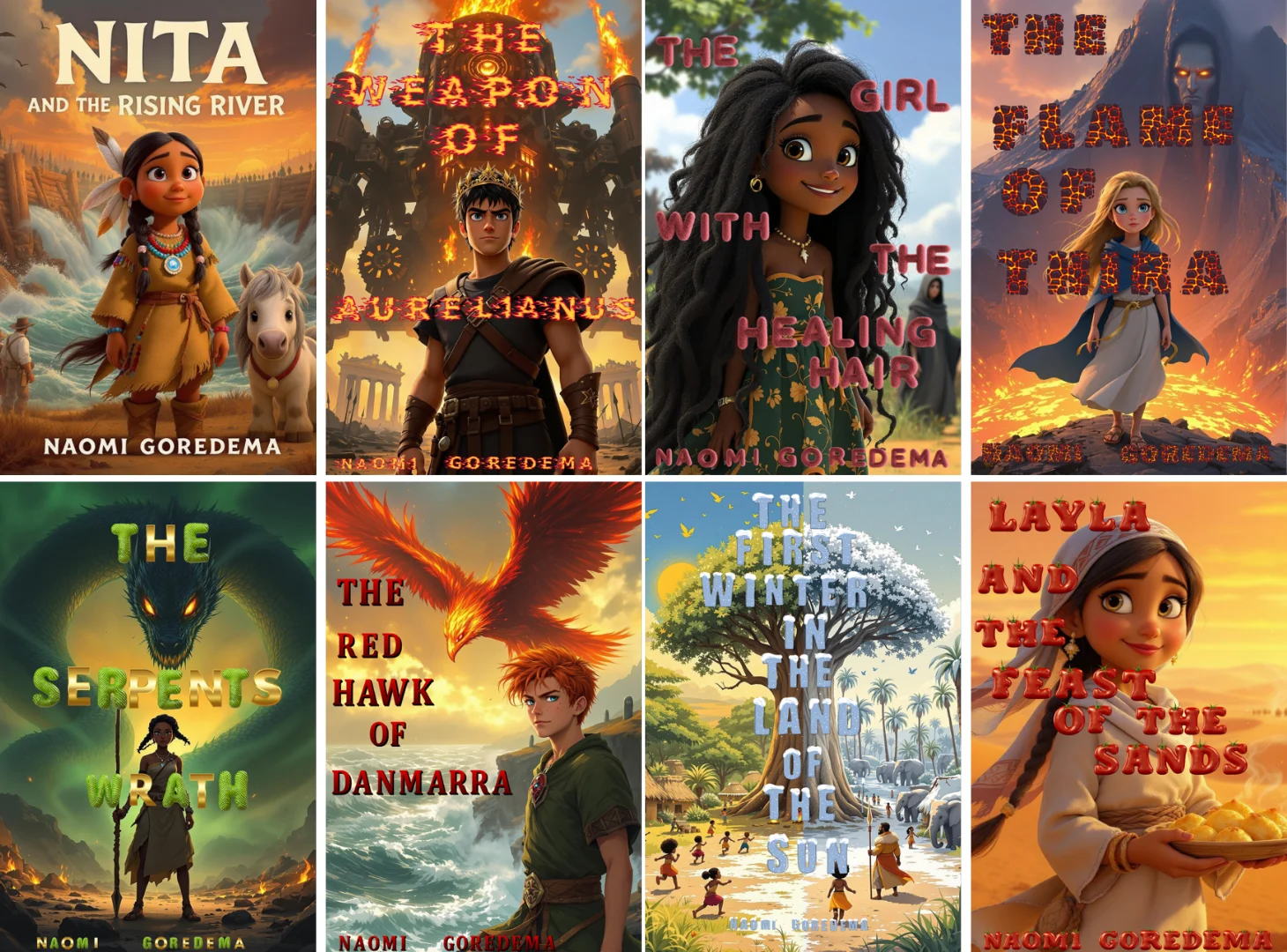
Finished children's book covers illustrated with Neolemon by author Naomi Goredema
20 books in 4 months. Naomi Goredema, children's author. Her old workflow took three days per character.

On Ideogram

The praise is for typography, design, speed, and support. The pain shows up under production pressure: strict control, character reliability, credit-rule changes, and slow queues.

"Better than every other model at text generation and design."

With one front-facing image, rear and profile views are invented, and "LORA is still the way to go" for full multi-view consistency.

Ideogram was "getting unusable" because generations got stuck in the queue for hours.

Take the praise seriously. For text and design it's earned. The complaints just happen to land on exactly the job we obsess over.

On Neolemon

Our proof is finished work, not tool reviews.

  • Patricia Wonsey, a former teacher, made over $1,000 in her first week selling coloring books built on Neolemon.
  • Brian McPhee shipped an 83-page book with 47 illustrations, 13 characters, and 12 stories.
  • Erica Weinstein built an 8-scene rom-com storyboard with the same cast across every scene.
  • "This app has become an invaluable tool in my creative process." Joanne Mohammed, children's author.
4.5★★★★★34 reviews, 94% 5-star on Trustpilot

Credit where it's due

Where Ideogram wins.

We'll go first. These are things Ideogram does better than us. If one is what your project needs, it's the right tool, and we mean that.

Text inside images

Posters, logos, t-shirt graphics, quote cards, cover titles. The category leader, and not close. We don't compete here.

Photoreal and broad styles

Realistic portraits, product shots, editorial scenes, any art direction. We're cartoon-only, so for photoreal, use Ideogram.

Visual ideation at scale

Twenty concepts in twenty styles in an afternoon, with style refs, palettes, magic prompt, and batch. Built for exploration.

Custom trained models

Fine-tune on 15 to 100 of your images for a brand or style system. If you already have a style bible, that's a real advantage.

Cheaper per raw image

Plus at $20 a month produces far more images than our Creator plan. For volume, the economics favour Ideogram.

A broad, mature API

Generate, edit, inpaint, reframe, background tools, upscale, custom-model training, even an MCP server for agents.

An ongoing free tier

10 slow credits a week, forever. Easier to keep poking at for free than a one-time trial, if privacy isn't a concern.

A bigger, funded company

Ex-Google Brain founders and roughly $100M raised. If "big platform" lowers your risk, that's a fair reason to pick it.

Use Ideogram for any of these and you'll get great work. If you later hit the wall most story authors hit on character drift, you know where we are.

Our turn, same rules

Where Neolemon wins.

Cartoon-only, on purpose. Built around the one job that breaks a general image generator.

Consistency is the product

Not a reference slot bolted onto an image tool. The whole workshop exists to hold one character steady across a story.

One editor per variable

Action, Expression, Outfit, and Perspective each change one thing. No fighting a single masked slot into doing every job.

Multi-character scenes

Compose one to three named characters with a background reference, the recurring-cast job a single reference wasn't built for.

A book production layer

Projects, Storyboard View, script notes, and PDF export. The boring "which image goes on which page" problem, handled.

Guided for non-artists

Structured fields instead of seeds and masks. You don't have to become an Ideogram power user to finish your book.

Private by default

Your characters and unpublished pages live in your Projects, not a public-by-default feed you can't easily delete.

Coloring books for KDP

Any scene becomes a print-ready coloring page in one click, a high-volume self-publishing category in its own right.

Founder-led support

A co-founder answers support email, even on vacation. If you'd rather email a person than a queue, that's the model.

Route yourself

Who should pick which.

Ideogram

  • You need readable text inside the image: a poster, logo, sticker, ad, or cover title.
  • You want photoreal humans, products, or lifestyle scenes.
  • You're exploring broadly across many styles, palettes, and concepts.
  • You have 15 to 100 images and want to train a custom brand model.
  • You're a developer or agency that needs a broad API.

Neolemon

  • A KDP author illustrating a 24 to 32-page book with one recurring hero.
  • You need pose, expression, outfit, and angle controlled separately.
  • Your story has two or three characters who reappear together.
  • You're building a cartoon series with a consistent cast.
  • You want structured steps, not seeds and masks, and private Projects.

Use both

  • Ideogram for the cover and its title typography.
  • Neolemon for the 32 interior pages of the same character.
  • Back to Ideogram for launch graphics, ads, and merch.

The hybrid workflow

Most authors don't switch. They add.

You don't have to pick one. Keep Ideogram for what it's great at, and bring the recurring-character work to Neolemon. Here's the path.

  1. 1

    Cover in Ideogram

    Strong title lettering and big visual exploration. Authors single this out as where Ideogram shines.

  2. 2

    Pull your best reference

    Download a clean, well-lit, slightly angled portrait of your character to carry over.

  3. 3

    Bring it into Neolemon

    Photo to Cartoon if it's a photo, or rebuild it in Character Turbo's structured fields.

  4. 4

    Generate the anchor

    One clean full-body front view. Every scene variation derives from this single anchor.

  5. 5

    Pose and emote

    Action Editor for poses, Expression Editor for feelings. Face and outfit stay locked.

  6. 6

    Build each scene

    Anchor plus action plus background, per page. Story Scene Pro for the multi-character spreads.

  7. 7

    Organize in Projects

    One project per book. Sequence panels in Storyboard, write the script alongside.

  8. 8

    Lay it out and ship

    The storyboard PDF is a draft, not a print interior. Finish at 300 DPI, then publish.

  9. 9

    Back to Ideogram to launch

    A+ content, brand-text social ads, and merch. Don't ask Neolemon to do those.

No half-truths

What to watch out for, on both sides.

Ideogram

  • Character reference is real but generalised; multi-view production tests report frequent misses.
  • Some controls disable each other when character reference is on.
  • "Up to 8,000 images" is the cheapest credit mode, not current 3.0 default.
  • Priority credits expire monthly; no subscription refunds.
  • Free outputs are public by default and hard to delete on free.
  • Slow queues can stretch to many minutes once priority credits run out.

Neolemon

  • Cartoon-only since 2025. For photoreal humans, Midjourney or Flux is the right tool.
  • Three or more characters in one frame still need iteration.
  • Fine details like fingers and intricate jewelry can vary across generations.
  • Multi Character V2 is square-aspect only; use Reframe for portrait layouts.
  • The storyboard PDF is a storyboard, not a print-ready KDP interior.
  • Commercial-use rights aren't copyright ownership, and KDP requires AI disclosure.

We'd rather lose a buyer to honesty than win one with a half-truth.

Questions

What people ask before switching.

What's the best Ideogram alternative for consistent cartoon characters?+

If your project is built around the same cartoon character across many scenes, a children's book, comic, lesson story, or social series, Neolemon is purpose-built for it. Character Turbo plus the Action, Expression, Outfit, and Perspective editors, Story Scene Pro, Projects, and Storyboard View cover the recurring-character job that Ideogram's single character-reference slot wasn't designed for.

Is Ideogram good for character consistency?+

Yes, in a specific way. Its character reference lets you upload one image and keep the same person recognisable across pose, outfit, lighting, and scene. It works well for single-shot identity transfer. For a whole 24 to 32-page storybook with controlled pose, expression, outfit, and multi-character variation, the workflow burden shifts back to you. That's the gap Neolemon fills.

Can Ideogram keep the same character across a whole story?+

Partially. Single-reference consistency is real and works for a handful of similar scenes. For longer sequences with extreme poses, side or rear views, or strict style locking, the mask-and-reference approach hits limits. Community testers on r/StableDiffusion reported the character feature was "a miss 50% of the time" on multi-view production tests.

Is Neolemon better than Ideogram for children's book illustrations?+

For interior illustrations with a recurring character, yes, our workflow is more directly built for that job. For the cover, especially if you need title typography, Ideogram is probably the better pick. A hybrid, Ideogram cover plus Neolemon interior, is what we recommend for most KDP authors.

Is Ideogram cheaper than Neolemon?+

Per raw image, yes. Plus at $20 a month produces far more images than the Neolemon Creator plan at $29. The difference reflects different jobs: Ideogram optimises for volume of general images; Neolemon optimises for the workflow cost of keeping a recurring character on-model. If your job is "make many images cheaply," Ideogram wins. If it's "finish a 32-page book where page 17 still looks like page 3," per-image price isn't the metric that matters.

What's the catch with Ideogram's "up to 8,000 images a month"?+

That number is the marketing line for Plus, achievable only on the cheapest credit mode. On the current 3.0 model the real math is closer to 2,000 Turbo, 1,000 default, or about 667 quality images a month from your priority credits. Slow credits then continue, unlimited but queued. It's not a scam, just how the credit table works.

Is Ideogram private?+

Only on paid plans. Free outputs are public by default, and private generation is Plus, Pro, or Team only. For unpublished book art, brand assets, or client work, you need a paid plan. On Neolemon, your generations stay private inside your Projects.

What about Ideogram custom models?+

They're available on Pro, Team, Enterprise, and API, trained on 15 to 100 images of a brand, character, mascot, or style. One data caveat: on Pro and Team, custom-model data may be used to evaluate and improve Ideogram's foundation models. Only Enterprise guarantees it won't be used for training or shared outside the organisation.

Does Neolemon do text inside images like Ideogram?+

No, and we won't pretend to. Rendering accurate words inside an image, for posters, logos, and cover titles, is Ideogram's strongest area. Neolemon's AI Canvas adds story captions and narration as text overlays on a cartoon page, which is a different thing from text rendered inside the artwork.

Can I use AI-generated characters commercially?+

Both tools allow commercial use under their paid plans' terms. Both come with the same caveat: commercial use is not the same as guaranteed copyright ownership, and AI content has evolving legal precedent. Amazon KDP requires disclosure of AI-generated images in submitted books. Evaluate copyright registrability, platform rules, and IP strategy independently.

Does Neolemon have an API?+

Yes. The V3 model is hosted on Segmind for reference-conditioned character generation, with a required character reference image and an optional pose reference. The web app exposes a broader surface, Story Scene Pro, AI Canvas, Coloring Book Creator, Projects, Storyboard View, that the V3 API doesn't. Ideogram's API is broader for general-purpose image work.

Can Neolemon replace Ideogram entirely?+

For interior illustrations and consistent characters across a cartoon storybook, yes. For typography-heavy covers, photoreal author photos, marketing graphics with brand text, or general design work, no, and we don't recommend trying. A hybrid Ideogram-plus-Neolemon stack is how most authors get the best of both.

The whole comparison, in one question.

What's the deliverable? If it's a single image, a poster, a cover, a photoreal scene, you wanted Ideogram. If it's a story where one cartoon character has to survive every page, you wanted Neolemon.

See if your hero holds up across 32 pages.

Run the character from your Ideogram project through the editors and watch the face stay put. 20 free credits, no card.

If Ideogram is the right tool for your project, use it. If consistency is what you're after, that's what we built.